Export Value Beef Botswana 115m 2014
SALEYARD prices for cattle are expected to increase by four percent on boilerplate over the next 12 months as depression supply constrains production and export volumes, according to ABARES' June quarter outlook report released today.
Prices to remain loftier as a result of tight supply
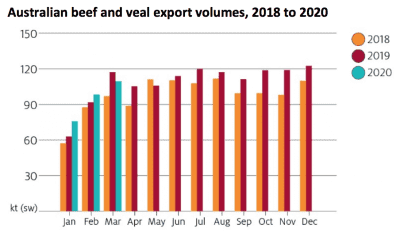
Click on images to enlarge
The Australian beef cattle herd remains at 30 year low, currently estimated at 21.i one thousand thousand head, the everyman since 1989-90.
Lower turn-off from the smaller national herd, and cattle being retained for restocking and herd rebuilding, will constrain beefiness production and exports over the short term.
With gradual restocking over the next 12 months ABARES expects the herd to increase to 21.v 1000000 head by June 2021.
Global need for beef is described as "robust" in the short term, but COVID-xix has increased uncertainty in export markets.
ABARES expects these factors to pb to a four per centum lift in the average saleyard toll of steers and cows in 2020–21, to 556 cents per kilogram.
Improved production weather in many eastern cattle areas
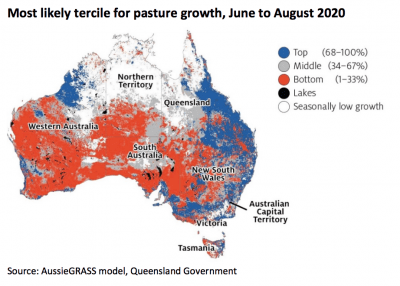
After two years of drought, widespread and above average rainfall earlier in 2020 has led to pasture growth in South Eastern Australia, with models also pointing to above average pasture growth over about of eastern Australia and particularly in Queensland over winter (see in a higher place map).
Wintertime is typically a period of low rainfall and pasture growth and a recovery in pasture biomass in the west and tropical north volition still require a more favourable monsoon in the summer of 2020–21.
Production to fall as herd rebuilding gains momentum
Australian beef production is forecast to autumn past 17 percent in 2020–21 to 1.ix million tonnes.
A seven pct fall in the number of cattle slaughtered since February has been partially kickoff by an increase in average slaughter weights, reflecting the high number of animals in feedlots and a failing share of females.
Female slaughter rates lower than effectually 47 percent indicate herd rebuilding is taking place. After averaging 56 per centum in 2019, female slaughter rates vicious to an average of 52pc in the first 3 months of 2020, and in Queensland averaged simply 44 percent betwixt Jan and May.
Female slaughter rates are expected to keep to fall throughout 2020 as herd rebuilding gains momentum, ABARES predicts.
However, information technology adds that the footstep of herd rebuilding will be express in some cases by the high price of restocker animals and limited cash flow after years of drought.
Beefiness consign volumes to fall
The volume of beef exports is forecast to fall past 22pc in 2020–21 to 995,000 tonnes, in line with the forecast fall in production.
However, the overall value of beefiness exports will not fall as significantly due to anticipated increases in consign prices.
In contrast to the forecast 22pc fall in export volumes in 2020-21, export value is forecast to autumn past 19pc to $8.ix billion (this is downwardly from $11 billion in 2019-20, when overall value of exports was enhanced past drought-related turn-off and loftier global prices).
Viral impacts
The ongoing shortage of protein equally a result of outbreaks of African swine fever in Prc has continued to back up global beef prices.
Data to March 2020 indicates that the overall impact of COVID-19 on Australia's beef exports has been small, ABARES said.
Average export unit values were 5 pct higher in the first quarter of 2020 compared with the previous quarter, and 16 percent higher than the same quarter last yr.
This was partly the issue of a lower Australian dollar, which depreciated sharply in March.
ABARES notes that exports of high-value products normally destined for foreign nutrient service channels were disproportionately affected early in the pandemic.
Commonwealth of australia is potentially well positioned considering of its low levels of community manual.
If Commonwealth of australia is able to maintain this status and go on its supply chains functioning efficiently, Australian beef producers may benefit from temporary supply disruptions in competing nations. Information technology could also help Commonwealth of australia build its reputation as a reliable supplier of quality meat.
How exports to key markets are expected to unfold
The volume of beef exports to China is expected to reach 324,000 tonnes in 2019–xx, up from 228,000 tonnes terminal twelvemonth.
Exports to the United States are forecast to accomplish 226,000 tonnes in 2019–20, 6pc lower than 2018–19.
Export volumes to other major markets such as Japan and Korea remained relatively unaffected past extensive COVID-19–related restrictions in both countries, with retail sales remaining relatively potent.
Live consign volumes to fall 25pc
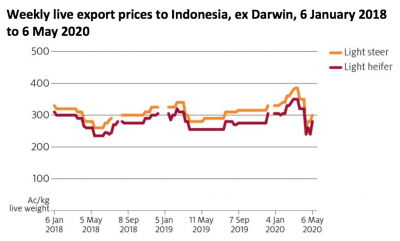
Live cattle export volumes are forecast to fall by 25pc in 2020–21 to effectually 900,000 head.
This reflects tighter domestic supply and falling demand equally responses to COVID-nineteen reduce household incomes in importing countries such every bit Indonesia.
On balance, average export prices are expected to increase slightly as the outcome of tightening supplies more than than offsets falling demand.
ABARES notes that this forecasts depends on "the uncertain duration and severity of COVID-xix impacts on need".
Changes in consumer preferences
Changes in consumer preferences in response to COVID-xix may benefit sales of Australian beef, the ABARES report suggests.
"For example, Chinese consumers have been substituting abroad from wet markets towards large supermarkets and online sales—distribution channels that favour Australian beef.
"The same consumer trend is axiomatic in Republic of indonesia, but this is leading to an increase in need for Australian boxed beefiness, and a decrease in demand for Australian live exports.
"In 2018 Commonwealth of australia accounted for 42pc of Indonesian beefiness imports (past value and volume), despite intense competition from cost-competitive Indian carabeef.
"Australian beef is typically sold in supermarkets, food service or hotels. Indian carabeef is typically sold in moisture markets, to bakso (meatball) manufacturers or in food service."
Tight profit margins for feedlot industry
After reaching a tape high number of animals in feedlots at the end of 2019, the number of animals on feed fell past 12[c in the March quarter of 2020.
Rapid pasture growth in the autumn of 2020 increased saleyard prices for feedlotters who are competing with restockers for a relatively pocket-sized supply of animals.
At the same time, responses to COVID-19 have increased doubtfulness in beef markets, and reduced returns for the loftier-quality grain-fed cuts favoured past export markets.
The number of animals on feed is probable to continue to fall in 2020–21, ABARES expects.
The study likewise noted the suspension of iv major abattoirs from the Chinese market, merely said it is nevertheless unclear how long these suspensions will last.
To view the full ABARES June 2020 report on the DAWE website click here
Source: https://www.beefcentral.com/news/cattle-prices-to-rise-as-production-exports-fall-abares/
0 Response to "Export Value Beef Botswana 115m 2014"
Postar um comentário