Chemical Engineering Easy to Get a Job
Become a Chemical Engineer in 2021?

Become a chemical engineer in 2021? Apart from mathematics and physics, chemical engineers should also learn chemistry and biological science because their responsibilities involve creating products out of raw materials, and they have to make sure that those products are non-toxic.
Let's find out if being a chemical engineer is right for you through these questions:
- What is the average salary of a chemical engineer?
- What is the job market like for chemical engineers? Would it be hard for you to get a job?
- What kind of education do you need to become a chemical engineer?
Let's get started.
Become a Chemical Engineer in 2021?
Chemical engineers are among those who have great contributions to society. These engineers play a role in the development of medicines, fuels, food and drinks, household products, and liquid chemicals, among others, which are all needed for us to survive.
They are important, especially now that there's COVID-19. You might be thinking that only the medical doctors and medical scientists are finding a way to stop the further spread of the virus, but chemical engineers are also taking action.
In fact, among the researchers who teamed up to identify the molecules that could kill the coronavirus were chemical engineers. The results of their research have been helpful for the discovery of vaccines and medicines for COVID-19.
1. What is the average salary of a chemical engineer?
Chemical engineers are among those who earn over $100,000 annually in the United States.
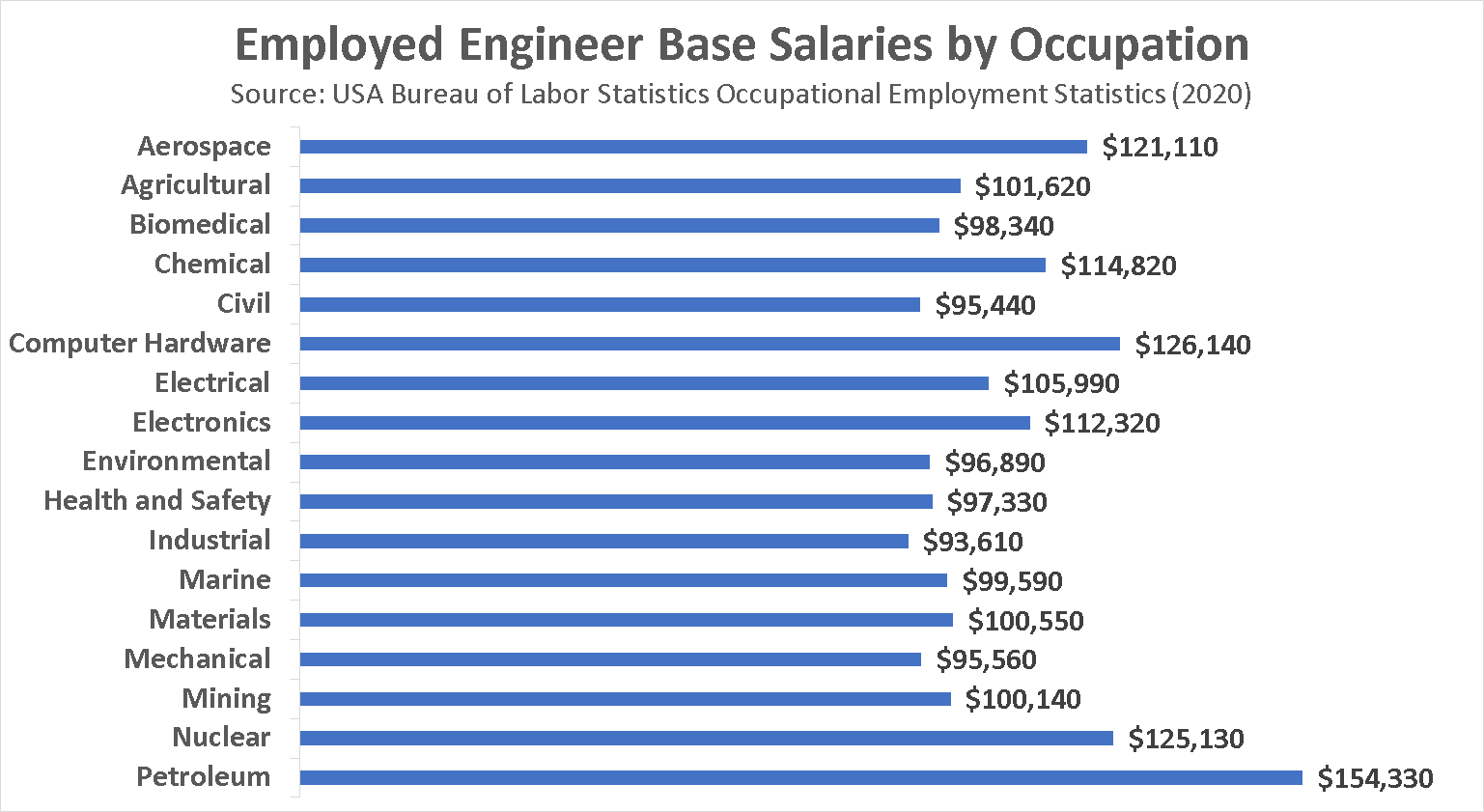
According to the Bureau of Labor Statistics, chemical engineers had a base salary of $114,820 in 2020. They were outearned by these engineers:
- Petroleum Engineers: $154,330
- Computer Hardware Engineers: $126,140
- Nuclear Engineers: $125,130
- Aerospace Engineers: $121,110
Chemical engineers earned $2,500 more than electronics engineers in the same year.
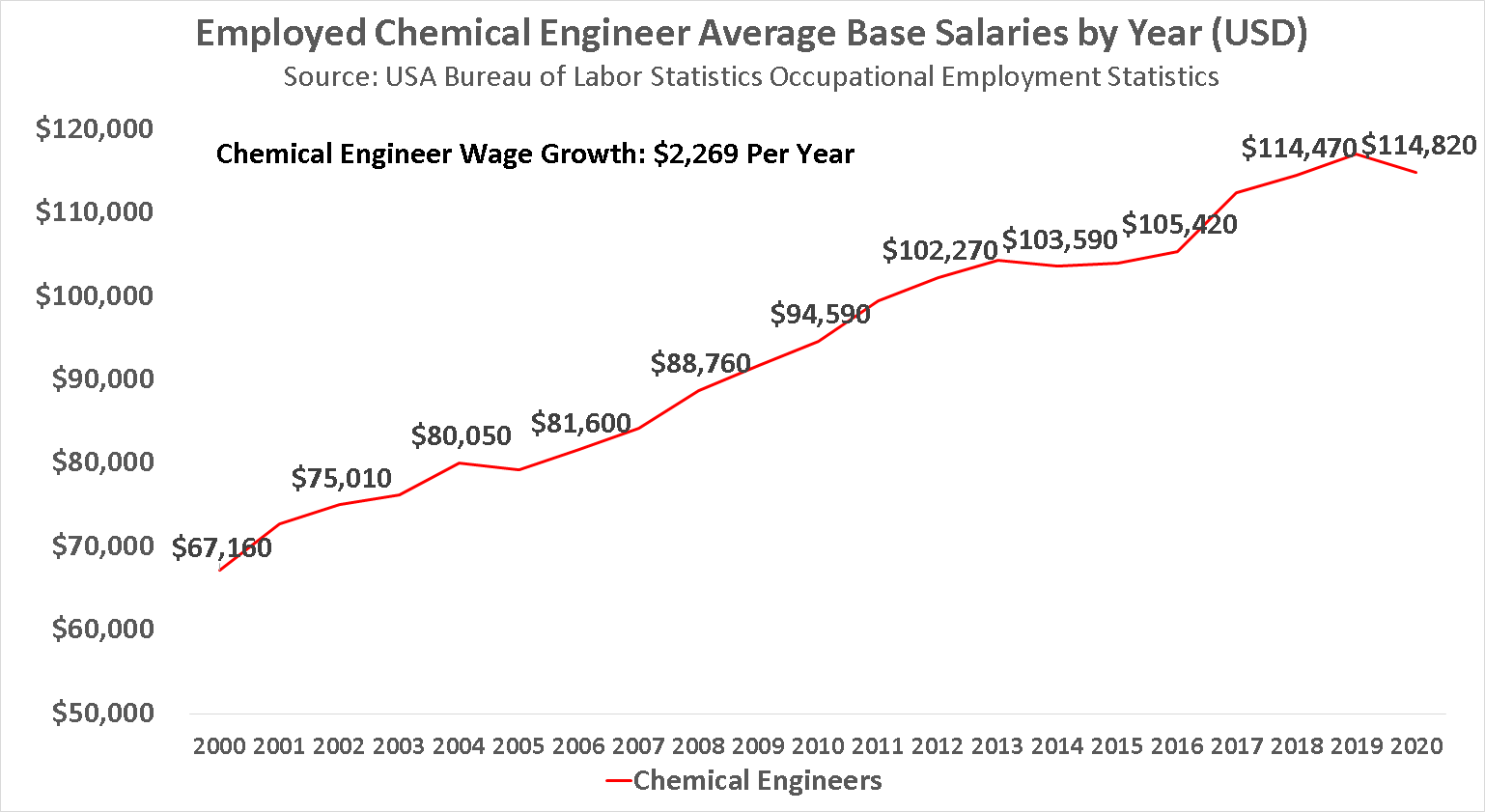
Even though the base salaries of chemical engineers from 2000 through 2020 were going up and down, there was an upward trend.
Chemical engineers in 2020 earned $47,660 more than in 2000. Based on the graph above, the wage growth is $2,269 per year.

And if the trend were to continue, the Bureau of Labor Statistics predicts that chemical engineers could earn up to $143,245 in 2030.

Chemical engineers could earn higher or lower than $114,820, depending on the state they are in. Based on the data from the Bureau of Labor Statistics, chemical engineers in Texas had a base salary of $138,600. That's the highest in the United States.
Here are the other states where chemical engineers were paid higher than $114,820:
- Delaware: $131,630
- Louisiana: $127,260
- New Mexico: $125,070
- Idaho: $123,400
- District of Columbia: $122,620
- Oklahoma: $121,120
- New Jersey: $120,710
- West Virginia: $119,250
- Maryland: $116,080
Those in Puerto Rico earned $70,960. That's the lowest in the United States.

In 2021, chemical engineers in the United States outearned those in other parts of the world, such as:
- Australia: $104,766
- Germany: $98,792
- Canada: $96,839
Those in the United States earned $16,281 more than those in Canada.
2. What is the job market like for chemical engineers? Would it be hard for you to get a job?
Chemical engineering isn't one of the engineering fields Americans would want to specialize in.

According to the Bureau of Labor Statistics, there were 25,770 chemical engineers in the United States in 2020. That was significantly fewer than:
- Civil Engineers: 300,850
- Mechanical Engineers: 293,960
- Industrial Engineers: 290,190
- Electrical Engineers: 185,220
- Electronics Engineers: 122,320
Chemical engineers outnumbered materials engineers by 1,030 in the same year.

Here's some bad news. From 2017 onward, the number of chemical engineers declined. It went down from 32,060 to 25,770.

Nonetheless, the Bureau of Labor Statistics sees that chemical engineers in the United States could increase. Let's assume they are right. In 2030, there would be 1,031 more chemical engineers.

Of those 25,770 chemical engineers, 5,800 were in Texas. Here are the other states where over 1,000 chemical engineers resided in:
- California: 1,910
- New Jersey: 1,130
- Louisiana: 1,080
- Ohio: 1,080
Only 40 chemical engineers were found in Nebraska, Nevada, and Rhode Island in 2020.

Now, would it be hard for you to get a job?
I used Indeed to find the number of job postings for this occupation. Job postings give us a real-time estimate of the demand for a particular occupation. It has been rated the most popular search engine for job seekers by several sites.
Searching for "Chemical Engineer" in the United States gave me a total of 5,242 job postings across the United States.

As there is 1 job opportunity for every 4.92 chemical engineers, getting a job wouldn't be difficult. There is a shortage of workers in this field.
3. What kind of education do you need to become a chemical engineer?
Chemical engineers should finish at least a bachelor's degree in chemical engineering and pass the licensure exam.

According to the Occupational Information Network, among the chemical engineers:
- 82% have a bachelor's degree
- 9% have a master's degree
- 9% have a doctoral degree
Those who didn't take further studies after college are significantly more than those who did. Engineering managers are more likely to consider graduate degrees and others.
Stay connected with news and updates!
Join our mailing list to receive the latest news and updates from our team. Your information will not be shared.
Source: https://www.careerwatch.co/blog/chemical-engineer
0 Response to "Chemical Engineering Easy to Get a Job"
Postar um comentário